
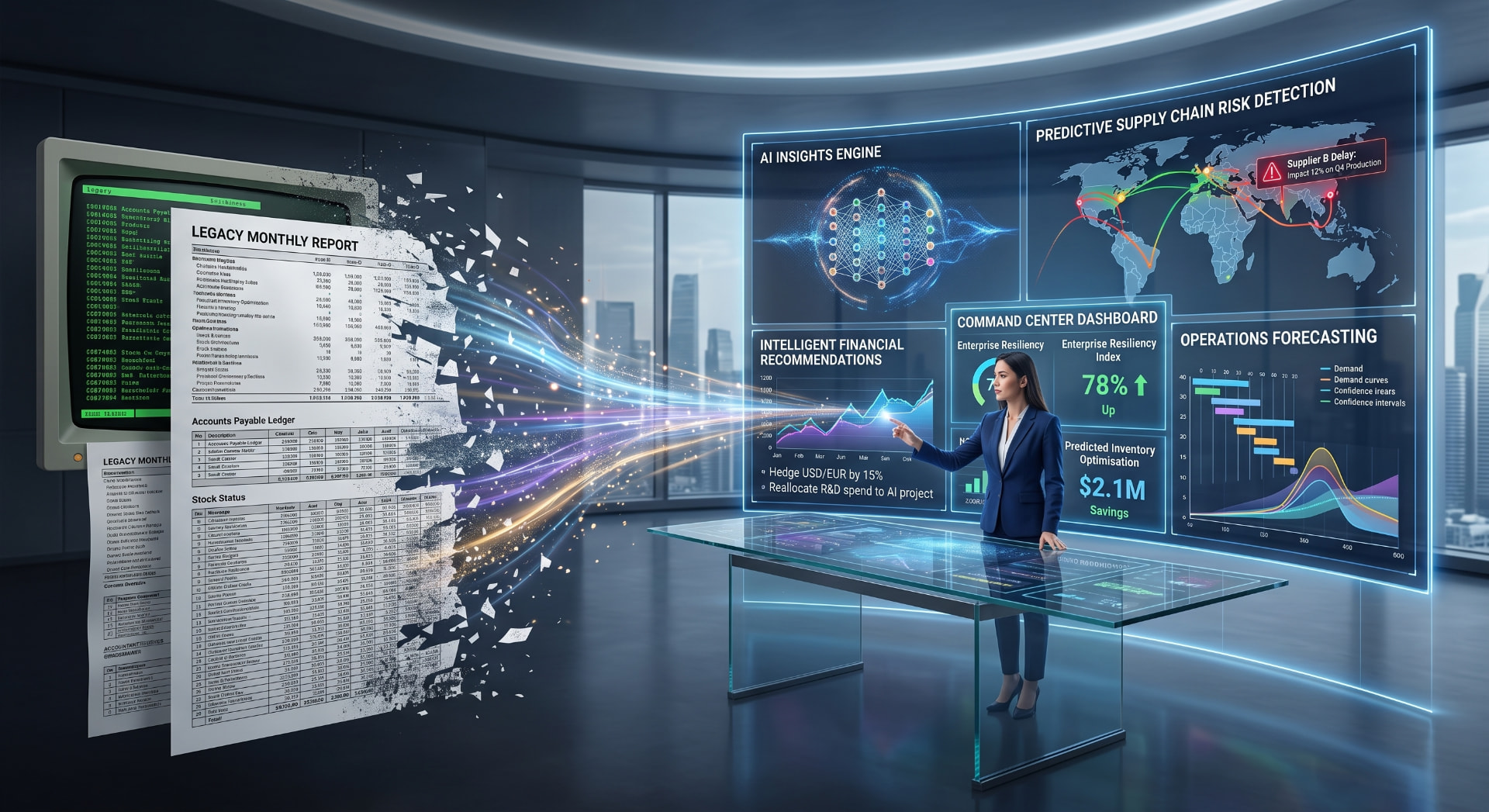
Nobody brags about their ERP at a cocktail party. But underneath that image problem sits the operational heartbeat of the enterprise — and AI is changing what it can do.
What you'll learn
- Why ERP has an image problem that undersells its strategic value
- How AI shifts ERP from reporting what happened to predicting what's next
- Where the biggest gains show up first: planning, finance, and supply chain
- What it means to move from systems of transaction to systems of intelligence
ERP has an image problem
ERP projects rarely generate the excitement associated with emerging technologies, and they seldom make headlines unless something goes wrong. For many organizations, ERP is viewed as necessary infrastructure — important, expensive, and often difficult to change.
Yet beneath that perception sits one of the most valuable assets in the enterprise.
ERP systems contain the operational heartbeat of an organization. Finance, procurement, inventory, manufacturing, logistics, planning, and workforce operations all pass through these platforms. If CRM helps organizations understand customers, ERP helps them understand how work actually gets done.
From visibility to foresight
For decades, ERP systems excelled at documenting business activity. They recorded transactions, tracked inventory, monitored costs, and generated reports. Their value came from visibility and control.
Today, that's no longer enough.
Business leaders are increasingly operating in environments defined by volatility. Supply chain disruptions emerge unexpectedly. Market demand shifts quickly. Labor shortages appear with little warning. Regulatory changes impact operations. Geopolitical events create ripple effects across entire industries.
Organizations don't simply need visibility anymore. They need foresight.
That's where artificial intelligence begins changing the conversation. Traditionally, ERP systems told organizations what happened. AI-enabled ERP systems can help organizations understand what is likely to happen next. The distinction may seem small, but the implications are enormous.
Planning and finance feel it first
Consider demand planning. Historical ERP systems excel at collecting data and generating forecasts based on known inputs. AI introduces entirely new possibilities by analyzing broader datasets, identifying emerging patterns, and continuously refining recommendations as conditions change.
The goal shifts from reporting on business activity to helping shape it.
The same dynamic applies across finance. Financial teams have historically spent significant time assembling information, validating reports, and identifying exceptions. AI can help automate portions of those activities while surfacing insights that may have otherwise remained hidden. Leaders spend less time gathering information and more time determining how to respond.
Supply chain: managing real complexity
Modern supply chains are extraordinarily complex systems. Inventory levels, supplier performance, transportation costs, customer demand, production schedules, and external market conditions all influence outcomes. Human expertise remains essential, but no individual can realistically evaluate every variable simultaneously.
AI expands an organization's ability to manage complexity. Instead of relying exclusively on static reports, intelligent ERP environments can continuously monitor conditions, identify risks, and recommend actions.
The objective isn't replacing human judgment. The objective is improving it.
From systems of transaction to systems of intelligence
At Hummingbird, we often describe this transition as moving from systems of transaction to systems of intelligence.
Transactions remain important. Businesses still need financial controls, inventory visibility, operational consistency, and regulatory compliance. None of that disappears.
What changes is the role ERP plays in decision-making. The platform evolves from being a repository of information into an active participant in business operations.
Where the Microsoft stack fits
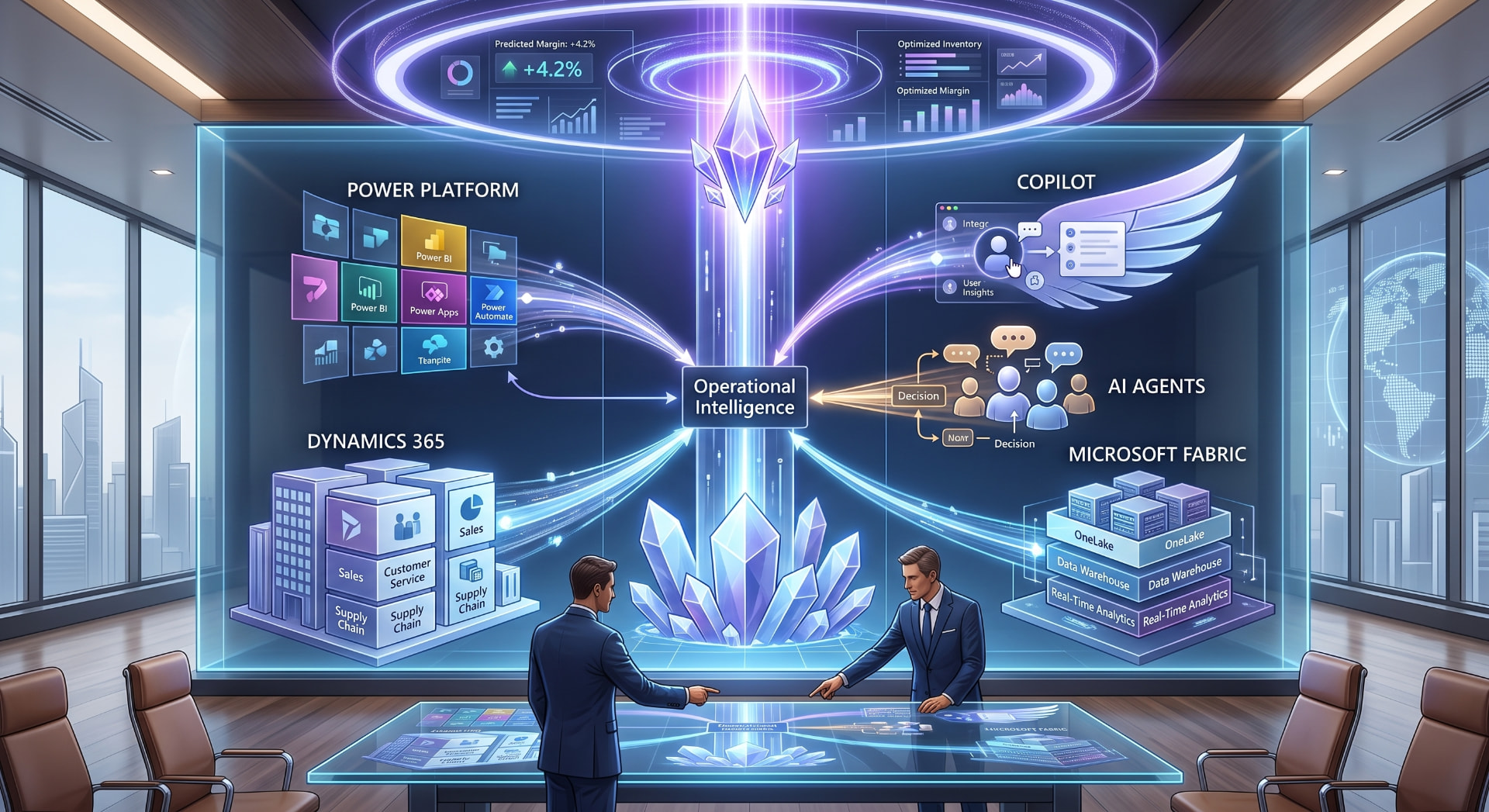 Operational intelligence formed from Dynamics 365, Power Platform, Copilot, AI agents, and Microsoft Fabric
This evolution becomes even more powerful when organizations connect ERP data to broader technology ecosystems. Microsoft Fabric, Dynamics 365, Power Platform, Copilot, and AI agents create opportunities to unify information from operational systems with information generated across the rest of the business.
- Financial information becomes more accessible.
- Operational signals become more visible.
- Insights become more actionable.
- Most importantly, decisions happen faster.
Why intelligent ERP matters
Organizations don't invest in ERP modernization because they enjoy upgrading software. They invest because they need better operational outcomes: faster decisions, improved planning, stronger resilience, greater agility.
AI accelerates those outcomes by helping organizations move beyond visibility toward prediction and optimization.
The organizations gaining the most value from ERP modernization today aren't simply installing new software. They're rethinking how information, intelligence, and execution work together. They're asking how AI can strengthen planning cycles, improve operational responsiveness, and support better decision-making across the enterprise.
That's a very different conversation than ERP projects of the past. For years, ERP modernization was primarily a technology discussion. Today, it's becoming a business intelligence discussion — and that shift may be one of the most important developments happening inside the enterprise right now.
What's next
ERP isn't disappearing. It isn't becoming less relevant. If anything, it's becoming more strategic than ever.
The difference is that ERP is no longer content to tell organizations what happened yesterday.
It's beginning to help them navigate tomorrow.
Thinking about what intelligent ERP could look like in your operation? Let's talk.