
Manufacturing companies have spent years debating whether to modernize Dynamics AX, GP, and NAV. Something has changed.
The conversation is no longer about infrastructure, support lifecycles, or moving to the cloud.
It's about AI.
Across manufacturing and distribution organizations, leaders are finding that the biggest obstacle to Copilot, AI agents, automation, and real-time decision making isn't a lack of innovation. It's decades of disconnected data, spreadsheet-driven processes, customizations, and aging ERP architectures.
This modernization wave isn't being driven by ERP requirements. It's being driven by the need for trusted operational data and AI outcomes that scale.
Why are manufacturers finally leaving AX, GP, and NAV behind?
Because those systems were never designed for what organizations are trying to do today.
Many manufacturers still run critical processes through a mix of ERP transactions, spreadsheets, custom reports, manual workflows, and years of custom development. It works. It also keeps them from moving at the speed the market now demands — spreadsheet-dependent planning, reporting complexity, inventory reconciliation, forecasting limits, and technical debt piled up one good decision at a time.
Modernization used to be justified with:
- Improved infrastructure
- Lower support costs
- Easier upgrades
- Better security
Executives are asking a different question now:
Can our current environment support the AI-driven business we want to become?
If the answer is no, modernization stops being an IT initiative and becomes a business one.
 Legacy systems on one side, AI-connected operations on the other — the transition most manufacturers are now facing.
Why is AI exposing ERP weaknesses faster than previous technology shifts?
Because AI only performs as well as the data behind it.
Organizations want to deploy Copilot, build agents in Copilot Studio, use Azure AI, and unlock analytics through Fabric. Then they discover AI can't create value when operational data is scattered across disconnected systems. An AI-ready data core has to come first.
The pattern shows up in every function:
| Area | Common challenge |
|---|---|
| Production planning | Spreadsheet-driven forecasting |
| Inventory management | Reconciliation across systems |
| Customer service | Incomplete customer information |
| Maintenance | Reactive decision making |
| Quality | Disconnected operational data |
Most organizations think they have an AI readiness problem.
More often, they have a data foundation problem.
What happens when customizations become the business?
They stop being an advantage and start being the ceiling.
Most AX, GP, and NAV deployments have accumulated years of modifications built to solve real operational problems. Individually, those calls made sense. Collectively, they make change expensive.
The consequences are familiar:
- Every upgrade becomes a project
- New capabilities arrive slowly
- Integration work gets harder
- Operational data becomes harder to trust
The issue isn't that customization was wrong. It's that yesterday's solutions become tomorrow's constraints.
 Fragmented reports and disconnected systems on one side, a governed operational data platform on the other.
What is replacing traditional ERP modernization?
Outcome-driven modernization.
The better Dynamics partners have moved past migration conversations and are helping organizations build modern operating platforms. At Hummingbird, that means three things working together:
Digital Modernization — moving manufacturers off fragile legacy environments onto governed cloud platforms, modern ERP capability, data platforms, and AI-ready architecture.
Manufacturing Customer Experience — connecting customers, dealers, service teams, and sales operations through modern engagement platforms and business applications.
Agent Factory — building AI agents that support supply chain, maintenance, quality, service, and sales using the Microsoft AI stack.
The goal isn't replacing software. It's better business outcomes.
Why are AI agents becoming the next competitive advantage?
Because the leaders have stopped experimenting and started operating.
Instead of asking "where can we use AI?", they're asking "which decisions should AI help us make every day?"
That turns into a network of specialized agents across:
- Production planning
- Supply chain coordination
- Quality management
- Maintenance management
- Service operations
- Sales enablement
Our Agent Factory approach builds reusable AI capability that scales across plants, teams, and functions rather than one-off pilots that never leave the lab.
This is where modernization and AI converge. Without modernization, agents lack trustworthy data. Without agents, modernization struggles to deliver transformational value.
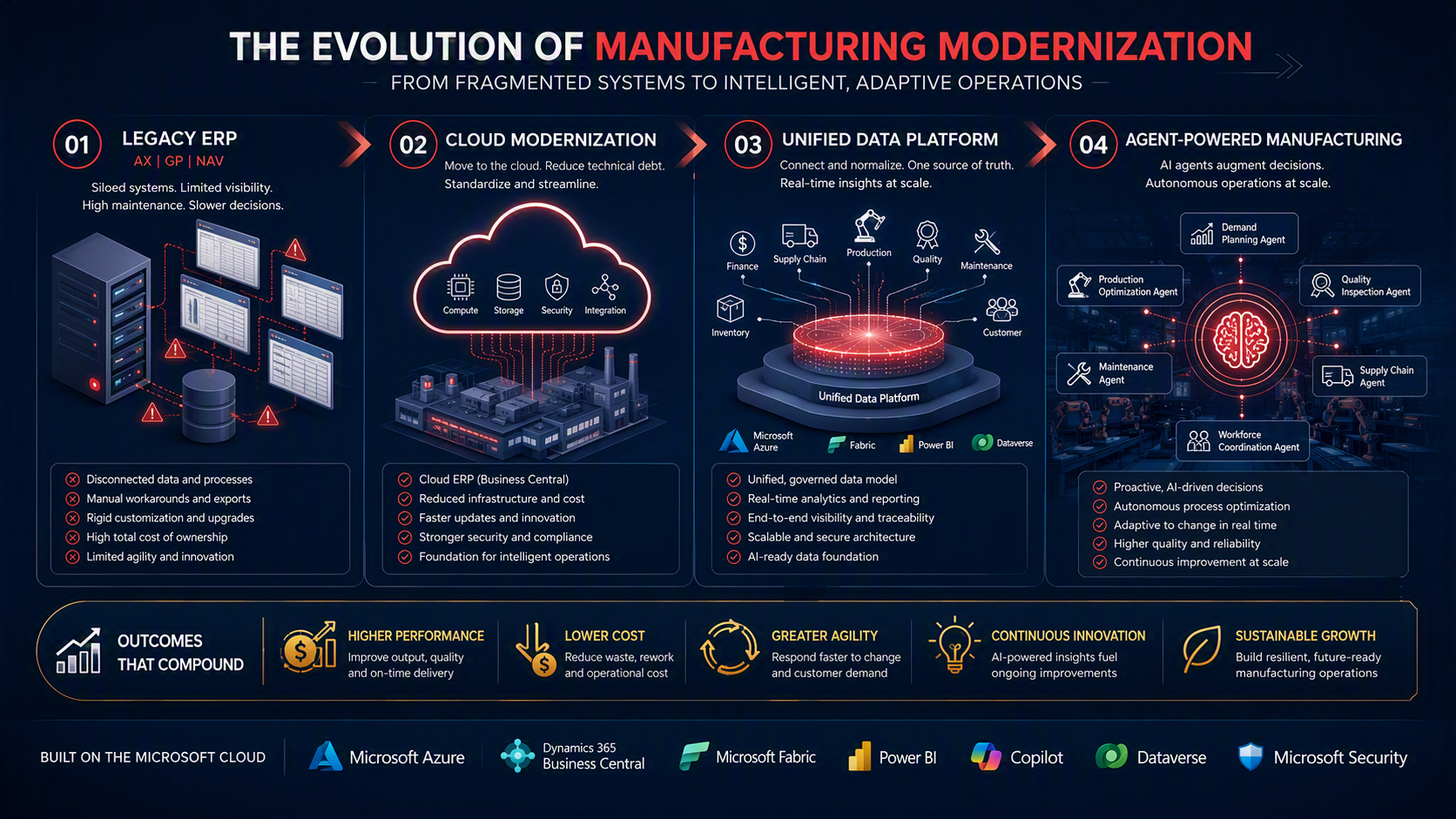 The evolution of manufacturing modernization — from legacy ERP to cloud, to a unified data platform, to agent-powered operations.
What should manufacturing leaders do next?
Widen the question.
Instead of asking:
- When should we upgrade?
- How much will migration cost?
- Which ERP features do we need?
Ask:
- Is our operational data trusted?
- Can AI reach the information it needs to create value?
- Are we reducing complexity, or adding to it?
- Can we scale innovation across sites and business units?
- Does this strategy support long-term business outcomes?
Those questions produce a very different roadmap. Usually a more valuable one.
The real modernization opportunity
The next decade of manufacturing won't be defined by who has the newest ERP. It will be defined by who has the most trusted operational data.
AI, Copilot, analytics, and agents are changing the economics of manufacturing operations. Legacy systems can keep running for years. The real question is whether they can support the business you're trying to build.
Modernization is no longer an ERP project. It's the foundation for enterprise AI — outcomes first, technology second, measurable value always.
FAQ
Is Dynamics AX still a viable ERP platform?
Plenty of organizations still run AX successfully. The strategic question is whether the architecture around it provides the data quality, integration, and agility future AI work requires.
Why are manufacturers modernizing ERP systems now?
To support AI, automation, analytics, and operational visibility — not simply to replace aging technology.
What role does data play in AI adoption?
Trusted, connected operational data is what lets AI, analytics, and agents produce real outcomes. Fragmented data caps what any of them can do.
What is an Agent Factory?
An approach to building and scaling reusable business agents across supply chain, maintenance, quality, sales, and customer service, instead of one-off pilots.
How should modernization success be measured?
Through business outcomes: operational efficiency, faster decisions, lower complexity, and readiness for what comes next.